Playbook · Skills & Capabilities
Public speaking for people who will never love it
You do not need to enjoy presenting. You need a structure that holds when your hands shake, and a rehearsal method that makes the first minute automatic. Both are learnable in a month.
Metanoia Editorial · 15 Sep 2026 · 6 min
What is happening
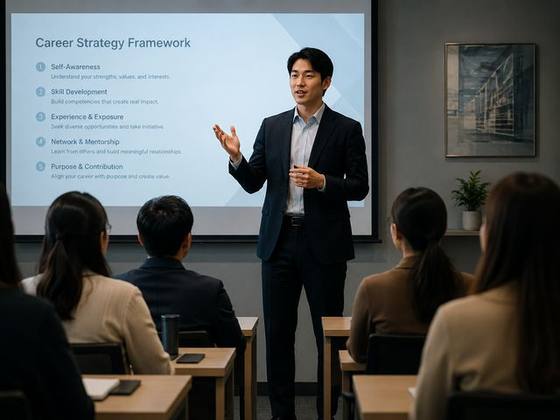
Nerves are not the problem; unstructured nerves are. Most weak presentations fail in the first ninety seconds, before the speaker has found a rhythm, and the cause is almost always that the opening was improvised. A fixed opening (what this is, why it matters to you, the one thing I will ask for) removes the improvisation from the hardest minute. After that, the body is just the one-page memo spoken aloud: answer, three reasons, risk, ask.
Rehearsal is where most people cheat: they read the slides silently and call it practice. Saying the words aloud, standing, with a timer, three times, is a different activity, and it is the one that works.
Why it matters
What this means for you
What to do
- Script the first three sentences word for word and memorise them. Everything after can be structured; the opening must be automatic.
- One idea per slide, one sentence of text at most. The slide is a signpost for the audience, not notes for you.
- Rehearse aloud, standing, timed, three times. Record the third and watch it once at double speed for the fillers and the pacing.
- Prepare the three questions you most hope nobody asks, and answer each in two sentences on paper.
- Breathe out before you begin, not in. A slow exhale is the one physiological trick that reliably steadies the voice.
Do it with the pillars
The RopeThe Rope’s Module 7 covers the presentation exercise inside an assessment centre, with the clock.
Sources & provenance
Written for
More in Skills & Capabilities

Playbook · Skills & Capabilities
Writing at work: the one-page memo that gets a decision
Most workplace writing asks the reader to do the thinking. A memo that leads with the answer, states what it needs, and fits on one page is the single most transferable skill we see.
9 Oct 2026 · 6 min read

Explainer · Skills & Capabilities
Learning how to learn: three findings that survive the lab
Rereading feels productive and teaches little. Three well-replicated findings from memory research, spacing, retrieval and interleaving, turn the first year of a job into a curriculum you actually keep.
7 Oct 2026 · 6 min read

Playbook · Skills & Capabilities
Spreadsheet fluency is the quiet superpower of a first job
Before anyone lets you near the real systems, they will hand you a spreadsheet. The person who can clean, structure, summarise and sanity-check one in an afternoon becomes useful in week one.
5 Oct 2026 · 7 min read